Spotlight
on Hazelnut Oil
The Common Hazel (Corylus avellana) is a deciduous shrub
cultivated for its nuts throughout Europe and western
Asia, Turkey accounts for 75% of worldwide production.
In the United States, hazelnuts are cultivated in Washington
and Oregon..
Hazelnut oil,
obtained from pressing the nuts, is a light, deep penetrating
oil with slight astringent properties. Used in cosmetics and
personal care products, these astringent properties make it
a good choice for oily and combination skin types. It is also
an effective moisturizer for dry skin types. The fatty acid
profile of hazelnut oil is similar to that of olive oil. In
fact, the profile of the two oils is so similar that the European
olive oil industry struggles with the illegal adulteration
of olive oil with hazelnut oil. Because chemical detection
of hazelnut tainted olive oil is so unreliable, the European
Union instituted certified tasting panels to detect adulterated
oil.
The similarities
prompted me to do a side by side comparison of the two oils
in soap making. First, let's take a look at the fatty acid
profiles and the SAP values:
| Fatty
Acid |
Olive
Oil
|
Hazelnut
Oil
|
| Lauric |
0
|
0
|
| Linoleic |
10
|
10
|
| Linolenic |
1
|
0
|
| Myristic |
0
|
0
|
| Oleic |
72
|
75
|
| Palmitic |
11
|
5
|
| Ricinoleic |
0
|
0
|
| Stearic |
4
|
3
|
| SAP
Value |
.135
|
.138
|
The
science supports the concept that the oils would behave
similarly in soap making, so I decided to see what would
happen in practice. I made side by side batches of soap
using 8 ounces of each oil:
|
Olive
Oil
|
Hazelnut
Oil
|
| Water |
3
oz
|
3
oz
|
| NaOH |
1.03
oz
|
1.06
oz
|
For
the sake of time, I used my favorite crock pot method to
make the soap. At a later time, I would like to conduct
the same experiment using the cold process method. The oils
used were extra virgin olive oil and cold pressed hazelnut.
As expected, both oils were very slow to reach trace, each
taking about the same amount of time. Once the soap reached
trace, the hazelnut seemed to move through the process more
quickly than the olive, but for the most part, they behaved
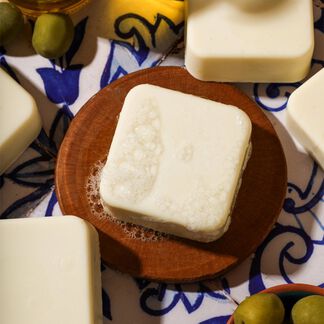
in the same manner. The resulting hazelnut soap was creamy
white, while the olive soap was light yellowish in color.
Personally, I liked the color of the hazelnut soap the most.
Both types of soap exhibited a similar degree of hardness,
and creamy lather, with small bubbles. At this point, I
have plans for more experimentation, but in a pinch, if
I were out of olive oil, I feel fairly confident that I
could successfully substitute hazelnut oil in it's place.
Published
in The Original Soap Dish® February 2009 Newsletter
Please
be aware that this article is the intellectual property of
The Original Soap Dish®. Protected
by copyright laws, it is not to be distributed or reproduced
in any manner.